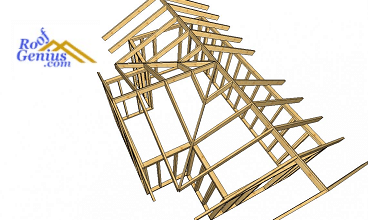
Popular Roof Terminology
Common roof terminology for
Composition shingles, Wood shakes, Metal roofs, Built-up roofing, and General roofing
Architectural Shingles – See laminated shingles.
Base sheet: An impregnated, saturated, or coated felt placed as the first ply in some low-slope roof systems.
Batten: (1) cap or cover; (2) in a metal roof, a metal closure set over, or covering the joint between, adjacent metal panels; (3) in a wood, a strip of wood usually set in or over the structural deck, used to elevate and/or attach a primary roof covering such as tile; (4) in a single ply membrane roof system, a narrow plastic, wood, or metal bar which is used to fasten or hold the roof membrane and/or base flashing in place.
Blind-nailing: The use of nails that are not exposed to the weather in the finished roofing system.
Built-up Roofing:- A roof consisting of multiple layers of asphalt and ply sheets.
Bundle:- A package of shingles or shakes. There are three, four or five bundles per square. Wood shakes and shingles are banded with a strap.
Butt Edge: The lower edge of the shingles tabs.
Cant strip: A beveled strip used under flashings to modify the angle at the point where the roofing or waterproofing membrane meets any vertical element.
Capillary action: The act of a liquid clinging to a horizontal surface.
Clipped gable: A gable cutback near the peak in a hip-roof form.
Closed Cut Valley: A method of valley treatment in which shingles from one side of the valley extend across the valley as shingles from the other side are trained two inches from the valley centerline. The valley flashing is not exposed.
Coping: The covering piece on top of a wall exposed to the weather, usually made of metal, masonry, or stone and sloped to carry off water.
Cornice: The decorative horizontal molding or projected roof overhang.
Counter batten: Vertical wood strips installed on sloped roofs over which horizontal battens are secured. The primary roof covering is attached or secured to these horizontal battens.
Counterflashing: Formed metal or elastomeric sheeting secured on or into a wall, curb, pipe, rooftop unit or other surface, to cover and protect the upper edge of a base flashing and its associated fasteners.
Cricket: A relatively small area of a roof constructed to divert water from a horizontal intersection of the roof with a chimney, wall, expansion joint or other projection. (see Saddle.)
Dimensional shingle: A shingle that is textured, overlayed, or laminated and designed to produce a three-dimensional effect. (also see Laminated shingle and Architectural shingles.)
Dome: A roof that is shaped like a half-circle, or a variation of one.
Dormer: This is a protrusion from the main roof, usually constructed to extend an upstairs living space.
Double-cut valley (Wood shake) A method of cutting 2 valley shakes for a course of shakes.
Drip edge: A metal flashing or other overhanging component with an outward projecting lower edge, intended to control the direction of dripping water and help protect underlying building components.
Eave: The very bottom of the roof. (This is where the gutters are located.)
Eyebrow: A dormer, usually of small size, whose roof line over the upright face is typically an arched curve, turning into a reverse curve to meet the horizontal at either end. Also, a small shed roof projecting from the gable end of the larger, main roof area.
Exposure: (1) the traverse dimension of a roofing element or component not overlapped by an adjacent element or component in a roof covering. For example, the exposure of any ply in a built-up roof membrane may be computed by dividing the felt width, minus 2 inches (51 mm), by the number of shingled plies; thus, the exposure of 36 inch (914 mm) wide felt in a shingled, four-ply membrane should be approximately 81/2 inches (216 mm); (2) the dimension of sidewall or roofing covering that is not covered or overlapped by the up slope course of component. The typical exposure for a standard-size, 3-tab shingle is 5 inches (127 mm), depending upon manufacturer specifications.
Fascia: (1) in steep-slope roofing, a board that is nailed to the ends of a roof rafter; sometimes supports a gutter; (2) in a low-slope roofing, the vertical or steeply sloped roof or trim located at the perimeter of a building. Typically, it is a border for the low-slope roof system.
Felt: Fiber material that is saturated with asphalt and used as an underlayment or sheathing paper.
Flashing: Pieces of metal or roll roofing used to prevent seepage of water into a building around any intersection or projection in a roof such as vent pipes, chimneys, adjoining walls, dormers and valleys. Galvanized metal flashing should be a minimum 26 gauge.
Gable: The upper portion of a sidewall that comes to a triangle at the ridge of a sloping roof.
Gable Roof: A type of roof containing sloping planes of the same pitch on each side of the ridge. Contains a gable at each end.
Galvanic action: An electrochemical action that generates electrical current between two metals of dissimilar electrode potential.
Galvanized steel: Steel coated with zinc for corrosion resistance.
Gambrel Roof: A type of roof containing two sloping planes of different pitch on each side of the ridge. The lower plane has a steeper slope than the upper. Contains a gable at each end.
Geodesic Dome: A rounded structure made of short, straight, triangular sections that form polygons.
Granules: Ceramic coated colored crushed rock that is applied to the exposed surface of asphalt roofing products.
Hip Roof: A type of roof containing sloping planes of the same pitch on each of four sides. Contains no gables.
Hip starter: (Tile Roof) A ridge tile that is rounded on one end to a closure. Used as the very first tile at the bottom of a hip.
Ice dam: A mass of ice formed at the transition from a warm to a cold roof surface, frequently formed by refreezing meltwater at the overhang of a steep roof, causing ice and water to back up under roofing materials.
Joist: Any of the small timbers, metal or wood beams arranged parallel to each other and spanning from wall to wall to support a floor, ceiling, or roof of a building.
Laminated Shingles: Strip shingles containing more than one layer of tabs to create extra thickness. Also called three-dimensional shingles or architectural shingles.
Low-slope roofs: A category of roofs that generally include weatherproof membrane types of roof systems installed on slopes at or less than 3:12 (14 degrees)
Mansard roof: A steeper roof that terminates into a flat roof at its high point
Modified bitumen: (1) a bitumen modified by including one or more polymers (e.g., atactic polypropylene, styrene butadiene styrene, etc.); (2) composite sheets consisting of a polymer modified bitumen often reinforced with various types of mats or films and sometimes surfaced with films, foils or mineral granules.
Open Valley: A method of valley construction in which shingles on both sides of the valley are trained along a chalk line snapped on each side of the valley. Shingles do not extend across the valley. Valley flashing is exposed.
Pie: An area of a roof with a valley on one side and a rake on the other and both come together at a point.
Pitch: This is the slope of the roof. It is the number of inches a roof rises vertically for every 12 inches of travel horizontally. A roof is typically referred to, for example, as a 4/12 or 4 pitch. The higher the number the steeper the roof. A 4/12 or 5/12 can be walked on with little difficulty. Above a 6/12 the roof is too steep to walk on comfortably.
Rafter: One of a series of sloped structural members, that extend from the ridge or hip to the downslope perimeter or eave, designed to support the roof deck and its associated loads.
Rake-starter (Bleeder strip): Starter-strip used along rake edges in conjunction with asphalt shingle roofing.
Rake: The sloped edge of a roof at or adjacent to the first or last rafter.
Rake tile: A tile that that fits over each field tile and hangs over the barge rafter.
Re-cover: The addition of a new roof membrane or steep-slope roof covering over a major portion of an existing roof assembly. This process does not involve removal of the existing roofing.
Reroofing: The process of re-covering, or tearing-off and replacing an existing roof system.
Release Tape: A plastic or paper strip is applied to the back of self-sealing shingles. This strip prevents the shingles from sticking together in the bundles, and need not be removed for application.
Ridge: The uppermost, horizontal external angle formed by the intersection of two sloping roof planes.
Ridge cap: A material or covering applied over the ridge of a roof.
Ridge vent: A ventilator located at the ridge that allows the escape of warm and/or moist air from the attic area or rafter cavity.
Roof assembly: An assembly of interacting roof components including the roof deck, vapor retarder (if present), insulation, and roof covering.
Roof covering: The exterior roof cover or skin of the roof assembly, consisting of membrane, panels, sheets, shingles, tiles, etc.
Roof jack: A metal or wood bracket used to support toe-boards on steep-slope roofs.
Roof overhang: A roof extension beyond the exterior wall of a building.
Scupper: Drainage device in the form of an outlet through a wall, parapet wall or raised roof edge lined with a soldered sheet metal sleeve.
Self-sealing Strip: Factory applied adhesive that bonds shingle courses together when exposed to the heat of the sun after application.
Sheathing : Boards or sheet material that are fastened to roof rafters to cover a house or building.
Shed roof: A roof having only one sloping plane and no hips, ridges or valleys.
Side lap: The continuous longitudinal overlap of neighboring like materials.
Single-ply roofing: A roofing system in which the principal roof covering is a single layer flexible membrane often of thermoset or thermoplastic membrane.
Snow load: The live load due to the weight of snow on a roof; included in design calculations.
Soffit: The exposed undersurfaces of any exterior overhanging section of a roof eave
Soffit vent: A manufactured or custom built air inlet source located at the downslope eave or in the soffit of a roof assembly.
Span: The horizontal distance from eaves to eaves.
Square: A square is a measure of 100 square feet (10′ x 10′ area). This is a common measure of the roof area.
Square Tab shingles: Shingles on which tabs are all the same size and exposure.
Starter course: The first layer of roofing, applied along a line adjacent to the downslope perimeter of the roof area. With steep-slope watershedding roof coverings, the starter course is covered by the first course.
Starter strip: Roll roofing or shingle strips applied along the downslope eave line before the first course of roofing and intended to fill spaces between cutouts and joints of the first course.
Steeple: A tower or spire, usually located on a church.
Steep-slope roofs: A category of roofing that generally include water-shedding types of roof coverings installed on slopes exceeding 3:12.
Step flashing: Individual pieces of sheet metal material used to flash walls, around chimneys, dormers and such projections along the slope of a roof. Individual pieces are overlapped and stepped up the vertical surface.
Substrate: The surface upon which the roofing or waterproofing membrane is applied (e.g., in roofing, the structural deck or insulation).
Telegraphing: Shingle distortion that may arise when a new roof is applied over an uneven surface.
Thatch Roof: The covering of a roof usually made of straw, reed, or natural foliage (palms) bound together to shed water.
Tie-in: In roofing and waterproofing, the transitional seal used to terminate a roofing or waterproofing application at the top or bottom of flashings or by forming a watertight seal with the substrate, membrane, or adjacent roofing or waterproofing system.
Torch-applied: Method used in the installation of polymer modified bitumen membranes characterized by using open flame propane torch equipment.
Underlayment: An asphalt-saturated felt or other sheet material (may be self-adhering) installed between the roof deck and the roof covering, usually used in a steep-slope roof construction. Underlayment is primarily used to separate the roof covering from the roof deck, to shed water and to provide secondary weather protection for the roof area of the building.
Valley: This is a point where two sections of roof come together and form a trough. Typically a pre-bent metal sheet is used to cover this area and the roofing material is overlapped onto the metal.
Vent: An opening designed to convey air, heat, water vapor or gas from inside a building or a building component to the atmosphere.
Ventilator: An accessory that is designed to allow for the passage of air.
Woven valley: A method of valley construction in which shingles or roofing from both sides of the valley extend across the valley and are woven together by overlapping alternate courses as they are applied.
Zipper: An area of a roof with valley on one side and hip on the other.